Why Teams Run Silkline with NetSuite

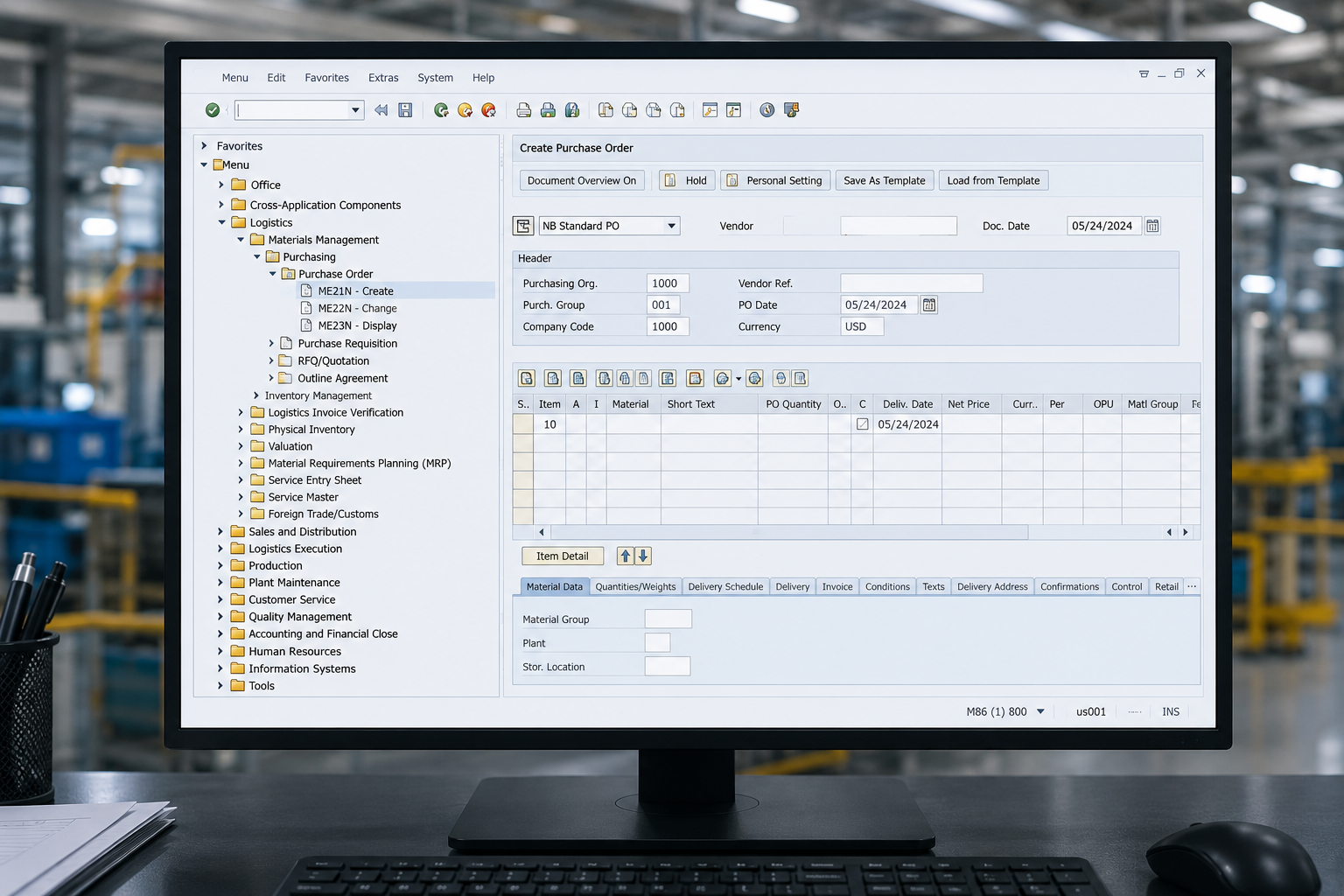
NetSuite is one of the best systems of record a growing manufacturer can pick. Keep it.
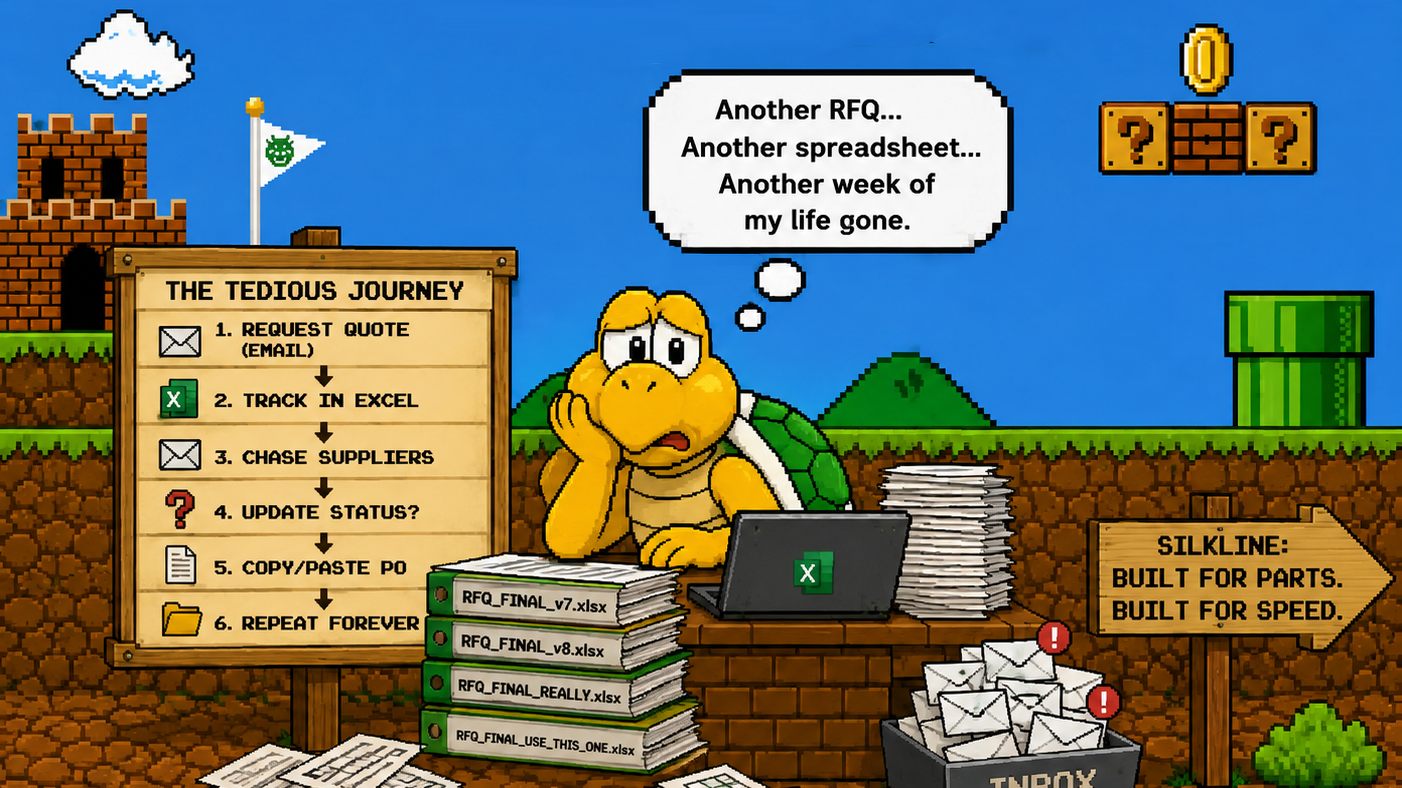
But a system of record... records. It doesn't chase a supplier for a confirmation or pick the quality clauses for a purchase order (PO). It doesn't prove a bracket on your flight unit traces back to a certified mill. That work happens before the transaction, mostly in email. It decides how fast you ship.
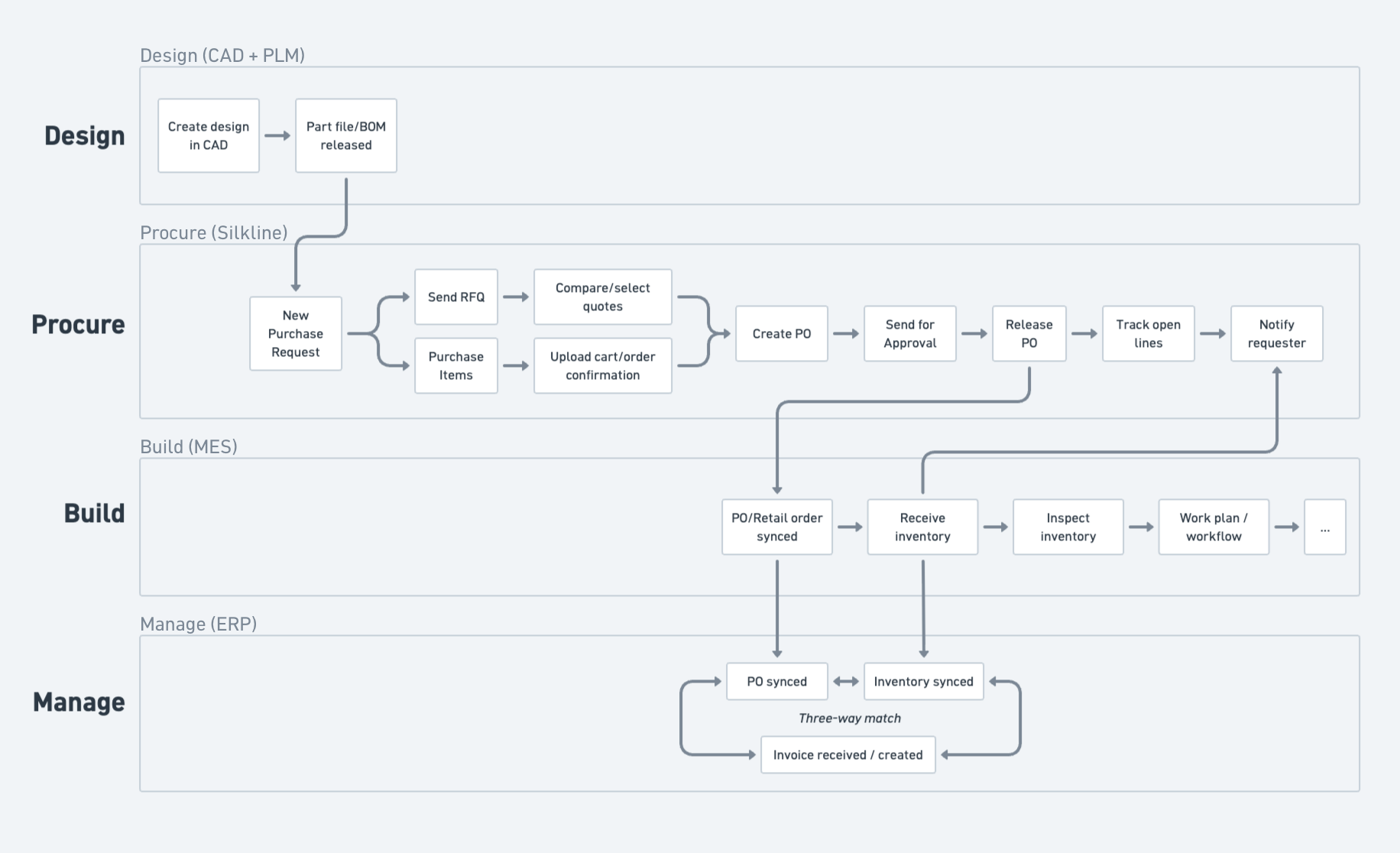
That's why teams run Silkline with NetSuite. NetSuite stays the ledger. Silkline runs the supplier and team work around it.
The Short Version
- NetSuite is a powerful, customizable enterprise resource planning (ERP) system for quickly growing companies. Finance trusts it.
- By Silkline's estimate, about 90% of procurement work happens outside any ERP. That includes quality clauses, flowdowns, and pedigree.
- Silkline captures that work and writes clean data back to NetSuite. In our experience, teams go live in about a week.
- The payoff is speed: in an illustrative model, milestone arrives 20 weeks sooner. Fewer seats and cleaner audits come with it.
Why Finance Loves NetSuite (and Should)
NetSuite earns its spot. Zycus credits it with handling "financials, inventory, and order management beautifully." It's customizable and grows with the company.
The on-ramp is easy too. Via the NetSuite BPO Partner Program, firms offer licenses "at a cost similar to other accounting solutions like QuickBooks." They can set up small business accounts in hours in most cases, per NetSuite.
Many startups start there. As they grow, they take over the same account with no reimplementation. NetSuite says it's becoming a solution of choice for private equity (PE) and venture capital (VC) firms.
NetSuite even goes past the ledger. Its Quality Management SuiteApp runs receiving and in-process inspections. Lot and serial tracking follows parts once they're in your building.
The open question is everything before a transaction exists.
The 90% That Happens Before (and After) the Transaction
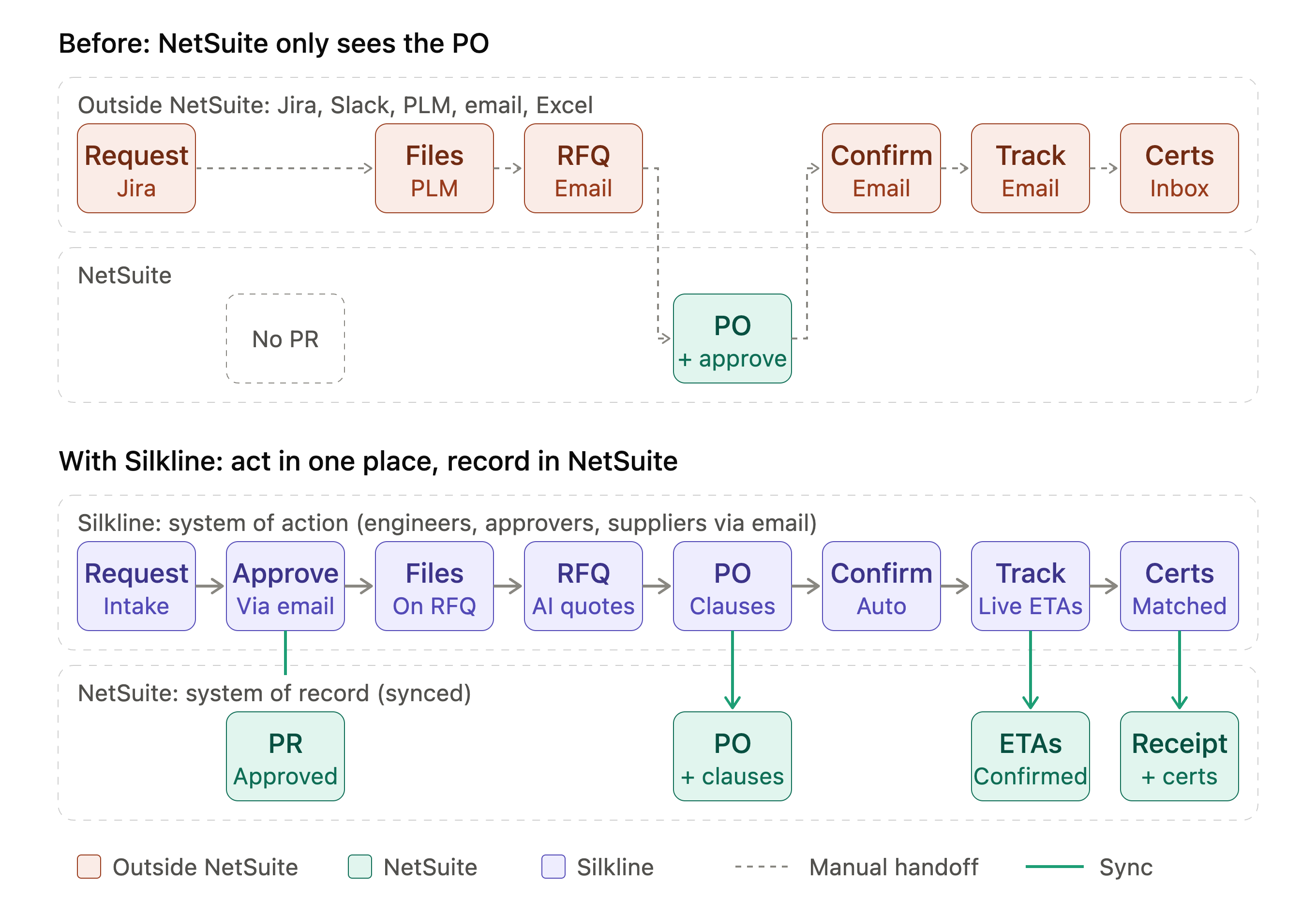
ERPs record what was agreed. Most procurement work is getting to the agreement. By Silkline's estimate, about 90% of it lives outside the ERP:
- Request intake from engineering
- Sourcing and requests for quote (RFQs)
- Supplier onboarding and document collection
- Deciding which quality clauses apply to each PO
- Flowing customer and regulatory requirements down to suppliers
- Collecting certs and Certificates of Conformance (CoCs) that prove part pedigree
- PO confirmations, follow-ups, and estimated time of arrival (ETA) changes
- Advance shipping notices (ASNs) and other shipping documents
- Reading data out of PDFs
- Supplier performance
Suppliers handle nearly all of this over email. NetSuite's Vendor Center gives them self-service PO access. Advanced portal capabilities typically need customization or third-party tools, per Anchor Group.
NetSuite also sells more depth through its separately purchased Advanced Procurement Module. Still, every ERP runs on transactions, and suppliers run on their inboxes.
Where Teams Feel Friction, Workflow by Workflow
Here's what we hear from teams running NetSuite. Most of it is possible with configuration, custom workflows, or extra modules. The cost is the build and the upkeep.
Request Intake
What we hear: Engineers avoid the purchase request form. It means repetitive clicking, hunting for data, and no updates after submitting. So buys start in Slack and spreadsheets.
With Silkline: Engineers submit requests without spreadsheets or tickets, and see status as buyers work each one.
Track: % of buys that start as a formal request.
Approvals
What we hear: Full routing is hard to see, and changes often need an admin. Out-of-office coverage takes workarounds. Approvers need a login and often lack context.
With Silkline: Approvers review requests with context and approve from email. Delegation covers time off.
Track: Median hours from request to approval.
Quality Clauses
What we hear: Clauses depend on the part. Build-to-print needs first article inspection (FAI), shelf-life material needs date codes, and outside processing needs approved processors. Buyers pick quality clauses memory and copy/paste them into the PO, causing quality and audit gaps.
With Silkline: Quality clauses attach automatically based on the part, category, and supplier. The PO goes out with the requirements that part needs.
Track: % of POs issued with the correct quality clauses.
Flowdown Management
What we hear: Your customers flow requirements down to you: DFARS clauses, ITAR, AS9100, counterfeit-parts prevention, and program-specific terms. You need to flow them to suppliers, yet this is a manual and error-prone process in most ERPs.
With Silkline: Flowdowns ride on the RFQ and PO. Supplier acknowledgment is captured and stored with the order, so the audit trail exists before anyone asks for it.
Track: Time spent manually setting flowdowns.
Pedigree and Traceability
What we hear: Flight and defense parts need a provable pedigree. That means CoCs, material and mill certs, and special process certs. It also means traceability to the original manufacturer or an authorized distributor. Pedigree is manually tracked as a custom field, without validations and controls.
With Silkline: Pedigree is tracked all the way from demand to receipt, with applicable quality clauses and controls in place to prevent escapes. Data flows onward for receiving/inspection workflows.
Track: T1 order lines placed with a supplier not qualified for T1.
Revision Control
What we hear: NetSuite handles revision control well for what you build. Revision records are assigned to assembly items for BOM control. Bill of materials (BOM) revisions require the Advanced Bill of Materials feature.
In our experience, purchased parts don't carry a rev unless teams model them as assemblies or customize. Wrong-rev orders are easy to miss.
With Silkline: Drawings, specs, and revisions attach to the RFQ and PO. Teams can check that the rev requested, quoted, ordered, and confirmed all match. Silkline flags mismatches early.
Track: Wrong-rev scraps per quarter.
PO Confirmations and ETAs
What we hear: Confirmations need custom workflows or manual chasing. Open order reports and ETA updates take real effort.
With Silkline: Automated email check-ins ask suppliers for confirmations and dates. Suppliers reply by email, and Silkline tracks statuses and ETAs in one place.
Track: % of open POs confirmed within 48 hours.
Supplier Onboarding and Master Data
What we hear: There's no lightweight way to quote with a new supplier before full onboarding. Capabilities and approval status by process are hard to capture, and data collection is manual. Anchor Group lists 2–3 week vendor setup as a common challenge, a directional partner figure.
With Silkline: Send RFQs to new suppliers by email, with no portal login. Store certifications, audits, and approvals by process in one place.
Track: Days to onboard a new supplier.
Search, Collaboration, and Data Entry
What we hear: Data is hard to find across the app, with no in-app tagging or messaging. Entering values on every line of a 100-line PO is repetitive. Supplier email sits outside the record.
With Silkline: Smart search covers orders and documents. AI document extraction pulls quote and confirmation data from PDFs. Supplier emails and files link to the order.
Track: PR to PO time; Ttouches per PO.
Why It Matters: Speed to Milestone
Each of those frictions adds days. Across a program, they set the biggest lever hardware teams have: time to milestone.
Here's an illustrative model for a new product introduction (NPI) program:
- The program needs 20 engineering cycles to reach a shippable milestone.
- Each cycle takes 4 weeks today.
- Better sourcing and fewer approval delays, ordering errors, quality escapes, and supplier issues cut cycles to 3 weeks.
That's 20 weeks earlier, roughly 5 months. A 200-person org at $250K fully loaded cost per person burns about $50M a year.
Value of time saved = weeks saved × (headcount × loaded cost ÷ 52)
Illustrative model, not Silkline customer data. Plug in your own numbers.
The ~$19M is the cost of 20 weeks of runway, not cash saved. It also leaves out reaching market and revenue sooner.
Better Sourcing Outcomes
Better sourcing also moves spend. One Silkline customer saw a 30% spread between high and low bids across 3,500 RFQs in one year.
That's a customer-provided figure, shared via Silkline. A spread isn't guaranteed savings, since the lowest bid may miss on lead time or quality. Still, it shows how much bids vary:
- Start with $10M of sourced spend.
- A 30% spread puts $3M between the highest and lowest bids.
- Capturing a third of that spread is about $1M.
Illustrative math. Your capture rate will differ.
With Silkline: Get bids from 10+ suppliers as easily as from two, all by email. AI document extraction pulls PDF quotes into one view for comparison.
Track: Spread between high and low bids per RFQ.
What Finance Gets From Silkline with NetSuite
NetSuite stays the system of record. Silkline makes that record more accurate and the stack cheaper to run.
A more accurate, up-to-date system of record. Supplier-confirmed dates, prices, and revs flow back to NetSuite through the integration. Open commitments reflect what suppliers actually confirmed.
Stronger validations and controls. Checks happen before the PO goes out. Revs match across request, quote, and order. Clauses and required documents attach by part, and approvals carry full context.
Lower total cost of ownership. NetSuite doesn't publish list prices, per ERP Cost Guide. Partner BrokenRubik estimates full user licenses at about $129–$199 per user per month. Self-service seats run about $15–$25 and typically cover time, expenses, PTO, or requests.
Occasional users like requesters, approvers, and engineers can work in Silkline or email, so fewer need full seats. Moving intake, approvals, clause logic, and follow-ups to Silkline also means fewer custom scripts to maintain.
Better operating outcomes. The goal is faster cycles, better sourcing, and fewer wrong-rev orders and quality escapes. Clauses, flowdown acknowledgments, certs, and approvals stay traceable to each PO. When an auditor asks, the answer is one search away.
What to Measure in Your First 30 Days
Supply chain leaders: start with your top 5 long-lead suppliers. Track cycle time, approval time, bid spread, confirmation rate, and cert completeness to measure progress against your baseline.
Illustrative figures only, not Silkline customer data. Use this table to set your baseline, then measure for 30 days.
Starter Checklist: 7 Steps This Week
- Audit seats. List full NetSuite users who mostly request or approve.
- Count quotes per RFQ. Pull your last 10 RFQs and count the quotes each one received.
- Count unconfirmed POs. Export open POs and flag any without written supplier confirmation within 48 hours.
- Time approvals. Measure hours from request to approval on your last 10 POs and take the median.
- Check on-time delivery. Pull last quarter’s receipts and compare each received date to the promised date.
- Spot-check certs at the dock. Pull 5 recent receipts and check whether the full cert package arrived with the parts.
- Add your own. Pick one or two metrics you already track and record today’s baseline.
Keep NetSuite. Add the Layer Around It.
NetSuite does the system-of-record job well. Silkline runs the supplier, quality, and team work before the transaction and keeps NetSuite's data clean. The result: faster cycles, better sourcing, fewer seats, and an audit-ready quality record.
Start by pricing one month of delay. Then get a demo to see how teams run Silkline with NetSuite.
About Silkline
Silkline is the supply chain orchestration platform that advanced manufacturing companies use to collaborate with suppliers; track requests, RFQs, quotes, and orders; and monitor team and vendor performance. Our technology sets the standard for how OEMs engage their supply base and is the connective layer for hard tech supply chains. Hundreds of advanced manufacturers use Silkline to operate more efficiently and speed up time to revenue. The company is headquartered in Chicago, IL. For additional information, visit https://www.silkline.ai.
© 2026 Silkline, Inc. All rights reserved. Silkline and the Silkline logo are trademarks of Silkline, Inc. All other brand and product names are trademarks or registered trademarks of their respective holders.