Procurement Management Software Was Never Built for Parts: How Silkline Differs From Coupa and Ariba

Bottom line up front: Procurement management software like Coupa and Ariba, the category often called business spend management (BSM), was built for indirect spend. That means the office supplies, software, and travel that keep a business running. It was not built for the engineered parts that become your product. So you bought a suite for spend control. Yet your Request for Quote (RFQ) process still lives in Excel and email. The cost is not procurement overhead. It is slipped ship dates, higher cash burn, compliance fines, and money left on the table.
Why Procurement Management Software and Parts Sourcing Are Different Jobs
Here is the open secret. A company signs a procurement software contract. Six months later, the buyers are still running RFQs in a spreadsheet.
The workflow tax is real. RFQs sit stuck in inboxes. Engineering flies blind on lead times. Nobody is doing anything wrong.
The problem is a mismatch. Buying paperclips and buying a machined titanium bracket are different jobs. One suite was designed for the first. Your product is made of the second.
How Silkline Differs From Coupa and Ariba Across Six Capabilities
Think of direct-parts sourcing as one lifecycle with six capabilities: Plan, Source, Procure, Track, Monitor, and Comply.
This is a design-center comparison, not a knock. Coupa and Ariba control indirect spend well. For engineered parts, the middle and back of this lifecycle tend to fall back to email and Excel outside the system.
The pattern is clear. BSM suites anchor the Procure step. The rest of the direct-parts lifecycle drifts back into email and spreadsheets.
BSM Was Built for Indirect Spend
This is not a knock. It is a design center.
- Ariba launched in 1996 to automate indirect procurement: the non-production goods and services a business buys to run itself, like office supplies and facilities upkeep.
- Coupa launched in 2006 for operating expenses: office supplies, travel, and temporary labor.
Direct spend came later, as an extension. The systems integrator advisory Nitor Partners says Coupa's direct-spend capabilities require "more configuration, more integration, and more compromise the deeper you push."
Ivalua takes a different path and positions to unify direct and indirect spend. The point is design center, not capability. These are choices about what each suite was built to do first.
That matters because of the math. In discrete and complex manufacturing, direct spend is the majority of total procurement. The bulk of your spend is the category most suites handle last.
A paperclip has no revision. A flight-critical fastener has a drawing, a revision, a spec, and a cert. Engineering specifies the exact part. Substitution is not allowed.
So direct sourcing needs things a catalog buy never does:
- BOM traceability across every line.
- Revision-controlled specs tied to each part.
- Engineering Change Order (ECO) management when the design moves.
- Quality documents: Certificates of Conformance (CoCs), material certs, source inspection.
What It Actually Costs You: Outcomes, Not Overhead
The real damage is not a bigger procurement department. It is what a manual parts process does to the business.
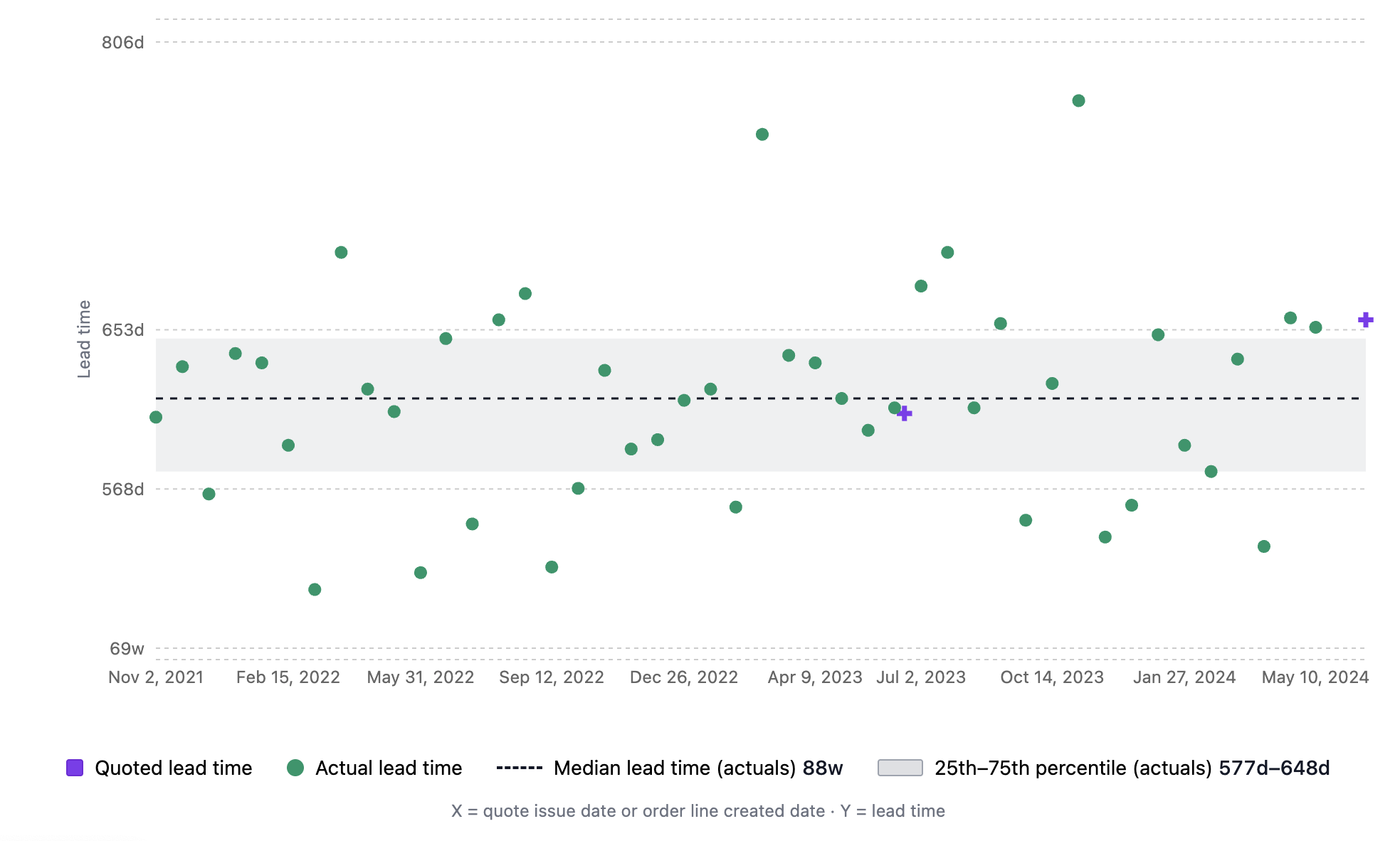
Delayed time-to-market. Parts shortages push build and ship dates. Deloitte's 2024 Aerospace and Defense Outlook reported production-material lead times of 87 days in August 2023. That was down from a 100-day peak in July 2022, but still above pre-pandemic levels. A 2025 Roland Berger survey of 130 supplier firms found two-thirds of aerospace companies still facing supply chain disruptions. Deloitte's 2025 Aerospace and Defense Outlook notes one major original equipment manufacturer's supply chain spans nine layers that contribute roughly 80% of jet components.
Higher burden rate and cash burn. Every extra week of lead-time variance keeps expensive engineering and build teams waiting. Burn accrues while the product does not ship. Longer cycles turn directly into cost.
Compliance fines. Enforcement is real and severe. RTX/Raytheon settled ITAR and related charges for more than $950M in October 2024, per Venable LLP. AS9100 certification is a contract requirement for suppliers to primes, per Wintersmith Advisory. Precision Advanced Manufacturing flags where ITAR risk starts, at the RFQ stage:
- Sharing controlled drawings with unvetted or foreign suppliers.
- Emailing technical data unencrypted.
- Uploading drawings to non-compliant storage.
Missed savings. When RFQs are manual, buyers solicit fewer competing quotes and default to incumbents. Less competition leaves price on the table.
The systemic picture backs this up. In January 2024, the Department of Defense named sub-tier supplier fragility and long lead times among its systemic challenges. That came in its first National Defense Industrial Strategy, per the Congressional Research Service.
The Portal Problem: Friction Kills Missions
Most spend suites ask suppliers to log into a portal. That asks the supplier to change how they work.
Friction has a predictable result. Adoption drops. Shadow procurement returns. Everyone goes back to email.
Here is the principle. Your machine shop will not adopt your portal on your timeline. Their job is cutting metal, not learning your software.
Zero friction means suppliers respond the way they already work: by email. You never ask them to change their behavior.
Run the Diagnostic: How Much of Your Process Lives in Your ERP or BSM?
Stop debating features. Measure your own process instead.
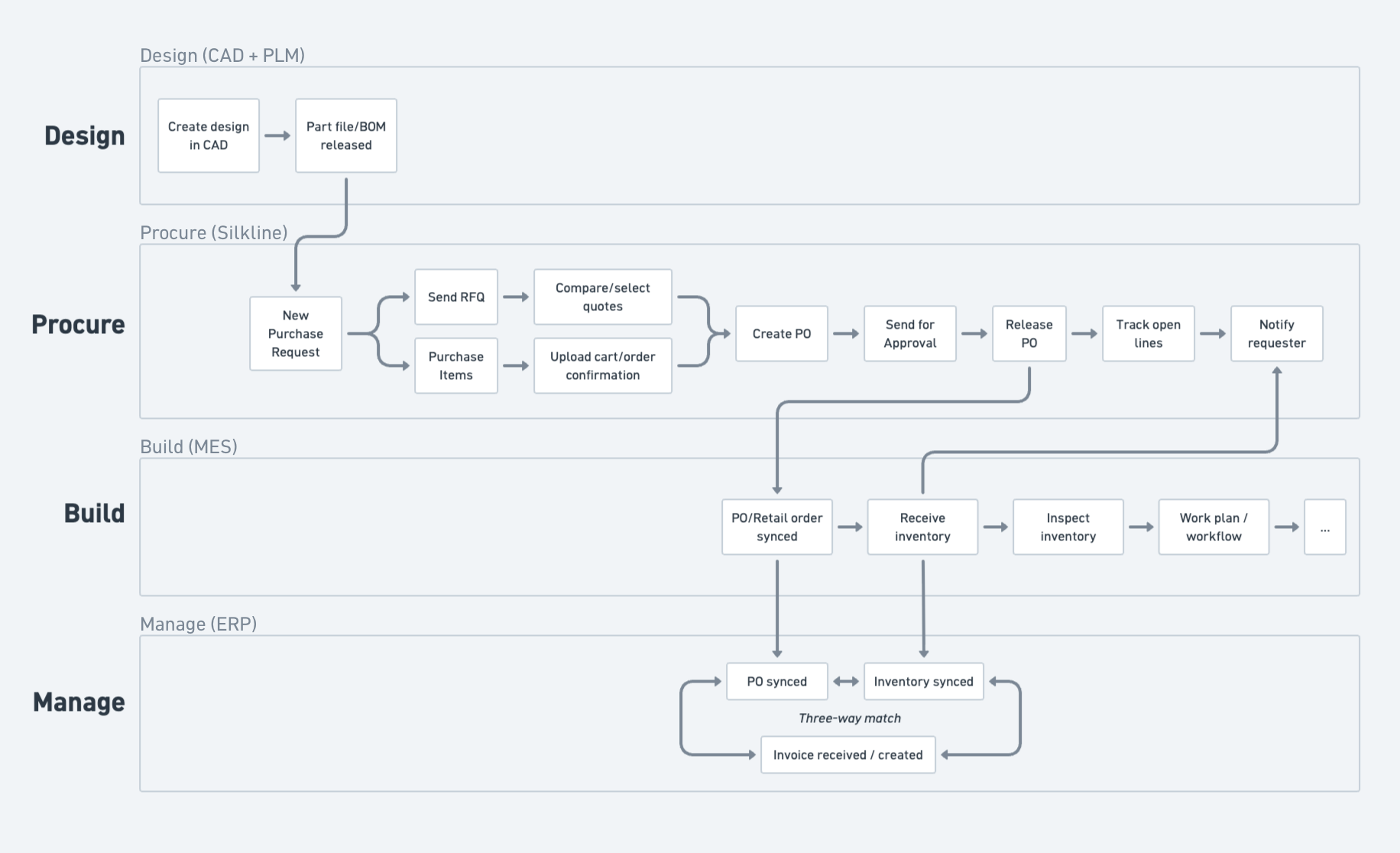
Map the path from demand signal to receipt. Mark where each step actually happens. Inside your Enterprise Resource Planning (ERP) or BSM system, or outside it in email, Excel, and PDFs.
Score it yourself:
- For each step, mark In-System or Outside.
- Estimate elapsed days per step.
- Count touches per step: the emails and handoffs it takes.
- Add it up: what percent of the ~28 steps truly live inside your ERP or BSM?
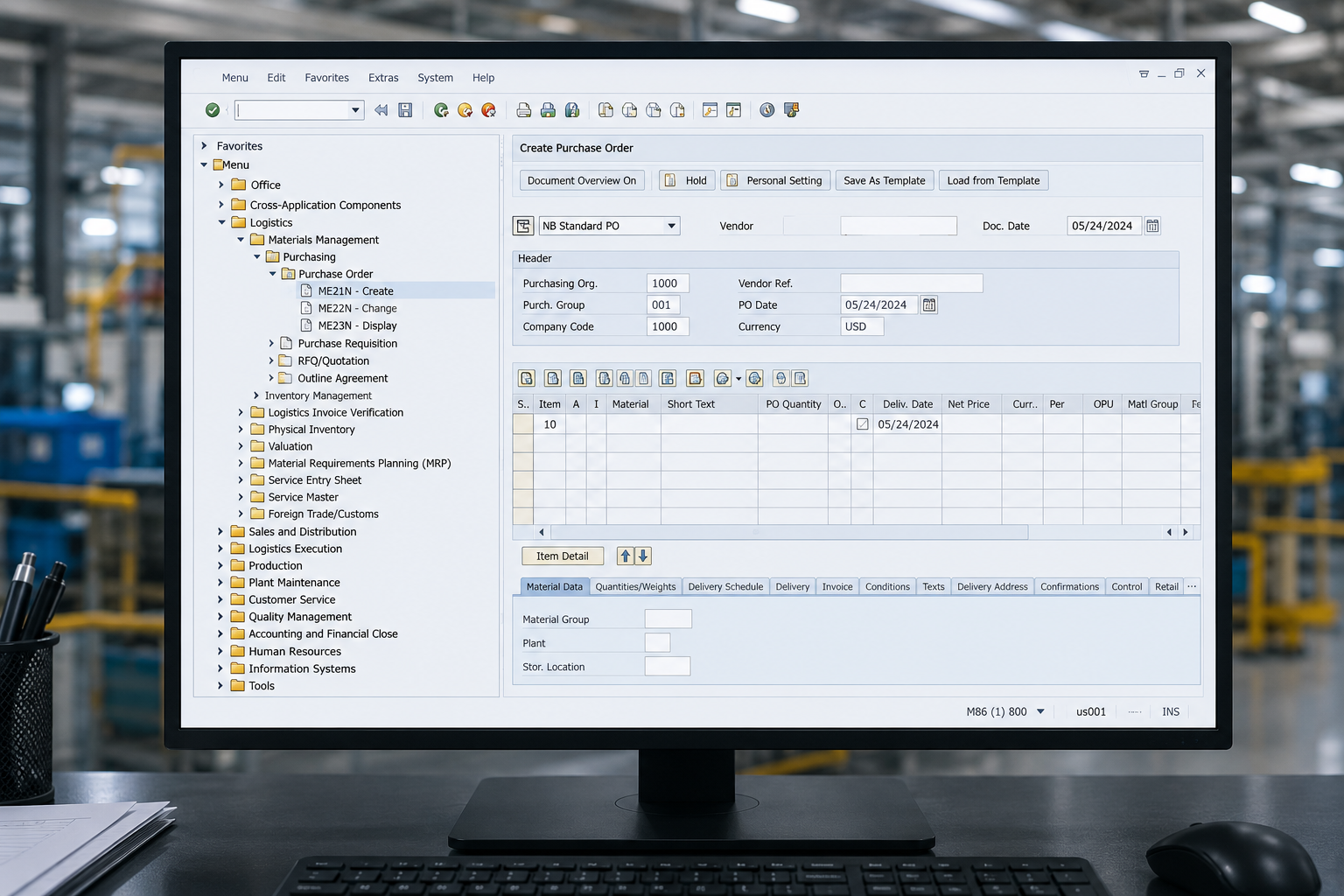
Most teams find only the PO steps live in-system. The large majority of the work lives in email, Excel, and PDFs: intake, sourcing, tracking, monitoring, and quality and compliance.
That gap is where lead-time variance, cash burn, and compliance risk accumulate. You can map it yourself with a spreadsheet. Silkline is built to close that gap, so the whole lifecycle runs in one place without forcing suppliers into a portal.
The Gap Is Architectural. You Can Measure It This Week.
The mismatch is not a setting you missed. Procurement management software like Coupa and Ariba was built to control indirect spend, and it does that job well. Direct parts run on different physics.
Run the diagnostic. Count the steps that live outside your system. That number is your opportunity, and no tool can promise it away.
Want to see the full parts lifecycle in one place, with suppliers still working by email? Get a Demo.
About Silkline
Silkline is the supply chain orchestration platform that advanced manufacturing companies use to collaborate with suppliers; track requests, RFQs, quotes, and orders; and monitor team and vendor performance. Our technology sets the standard for how OEMs engage their supply base and is the connective layer for hard tech supply chains. Hundreds of advanced manufacturers use Silkline to operate more efficiently and speed up time to revenue. The company is headquartered in Chicago, IL. For additional information, visit https://www.silkline.ai.
© 2026 Silkline, Inc. All rights reserved. Silkline and the Silkline logo are trademarks of Silkline, Inc. All other brand and product names are trademarks or registered trademarks of their respective holders.