Procurement Orchestration for Advanced Manufacturing

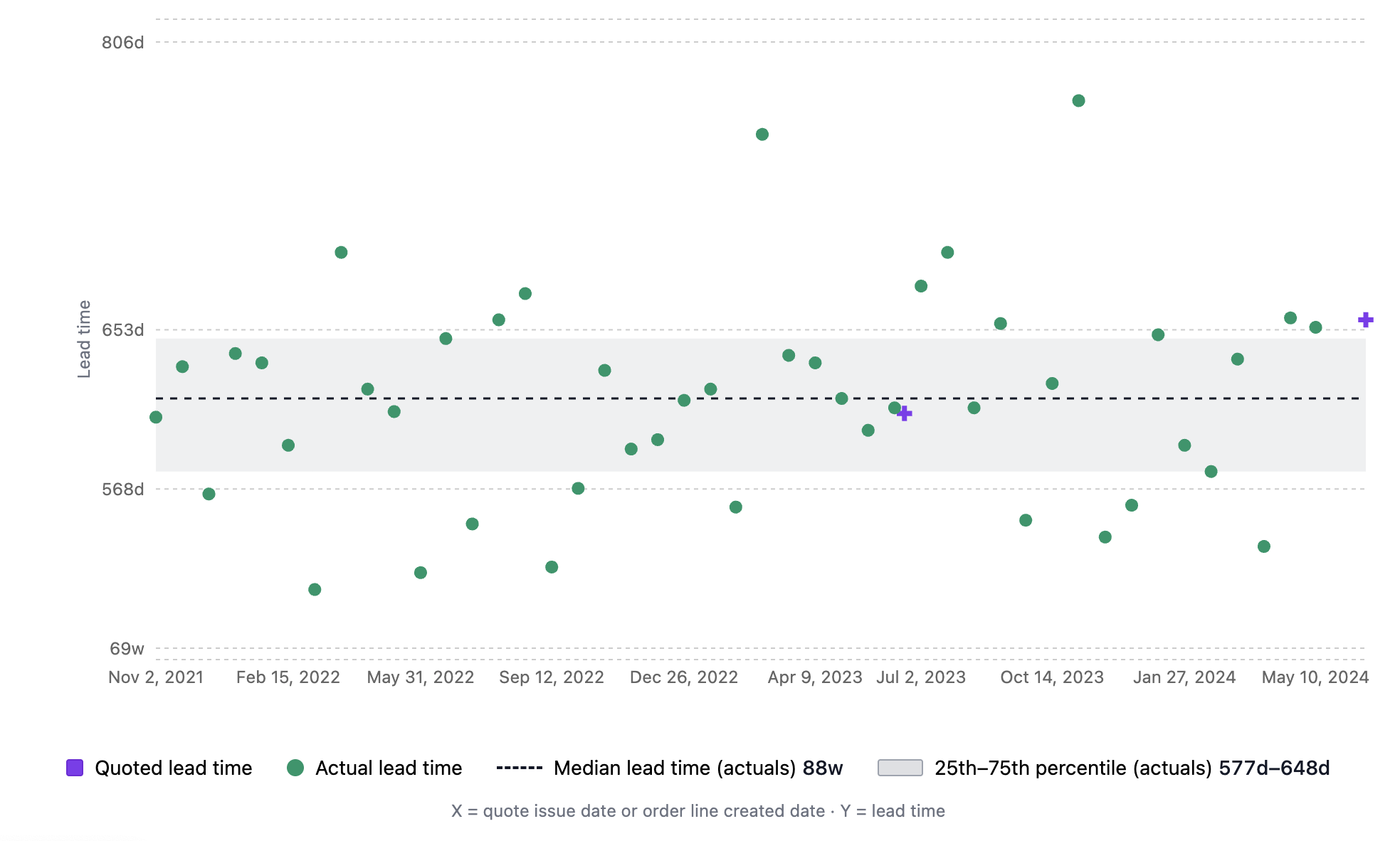
Advanced manufacturing organizations operate in environments defined by complexity: long lead times, frequent engineering changes, strict quality requirements, and deeply interconnected supplier networks. In these settings, procurement is a strategic function, enabling growth and profitability.
As production programs in aerospace, space, defense, energy, robotics, and other advanced manufacturing industries grow more sophisticated and supply chains become more dynamic, many organizations are finding that traditional procurement systems no longer provide sufficient visibility or control. This gap has led to the emergence of procurement orchestration as a distinct capability within the advanced manufacturing technology stack.
What Is Procurement Orchestration
Procurement orchestration is the coordination of supply chain activities for an advanced manufacturing organization encompassing functions, suppliers, and systems throughout the sourcing lifecycle.
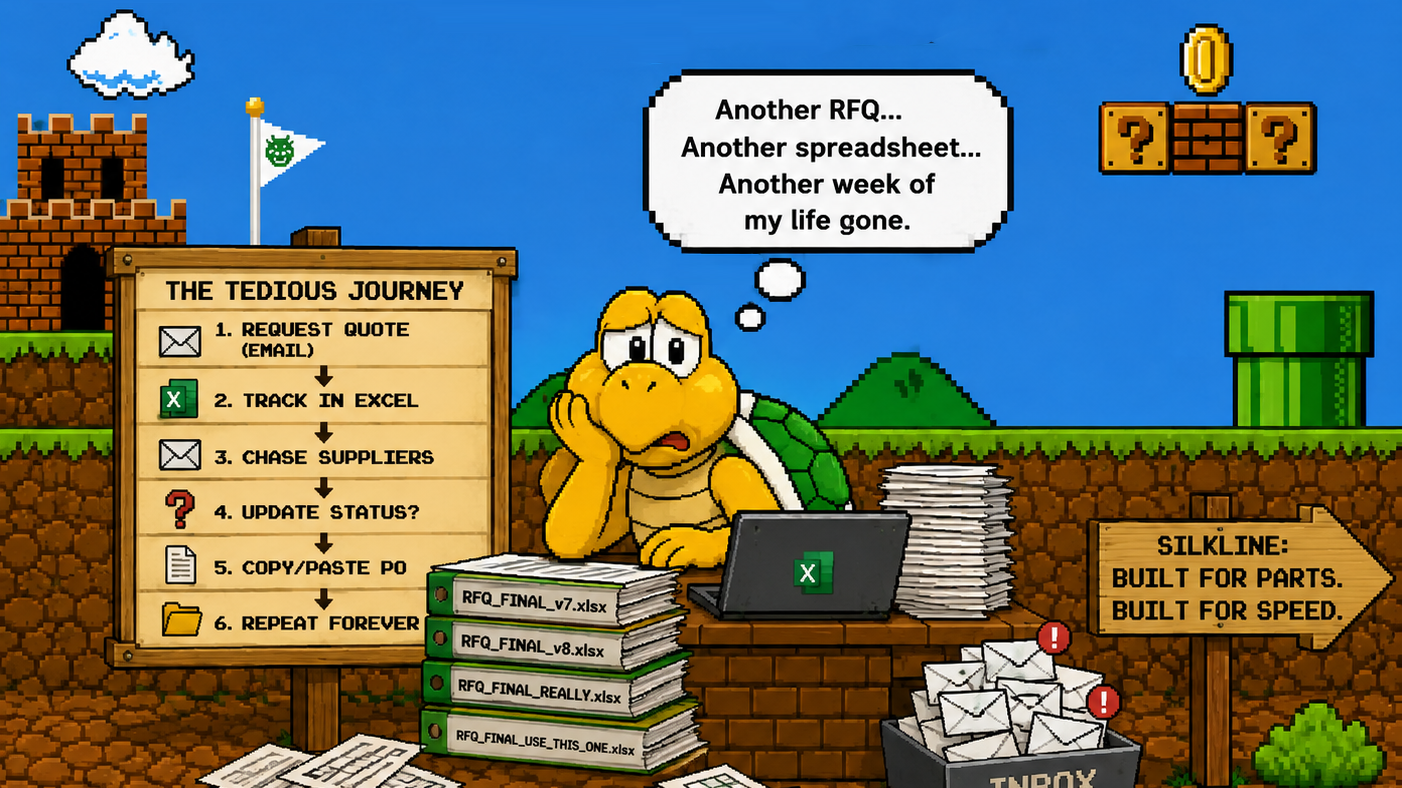
In advanced manufacturing, procurement work spans multiple systems and stakeholders. Purchase requests originate in engineering or operations. RFQs are issued to suppliers through email. Quotes often arrive in unstructured formats. Approvals follow complex rules. Purchase orders must align with production schedules, quality requirements, and compliance obligations.
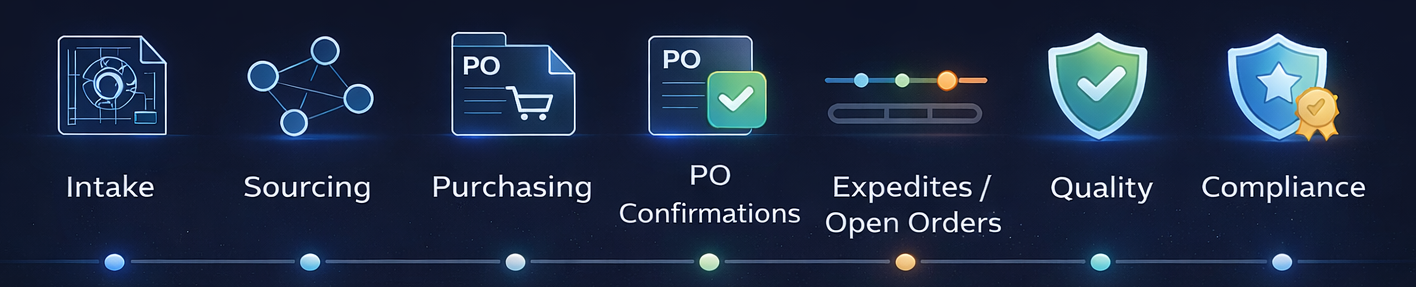
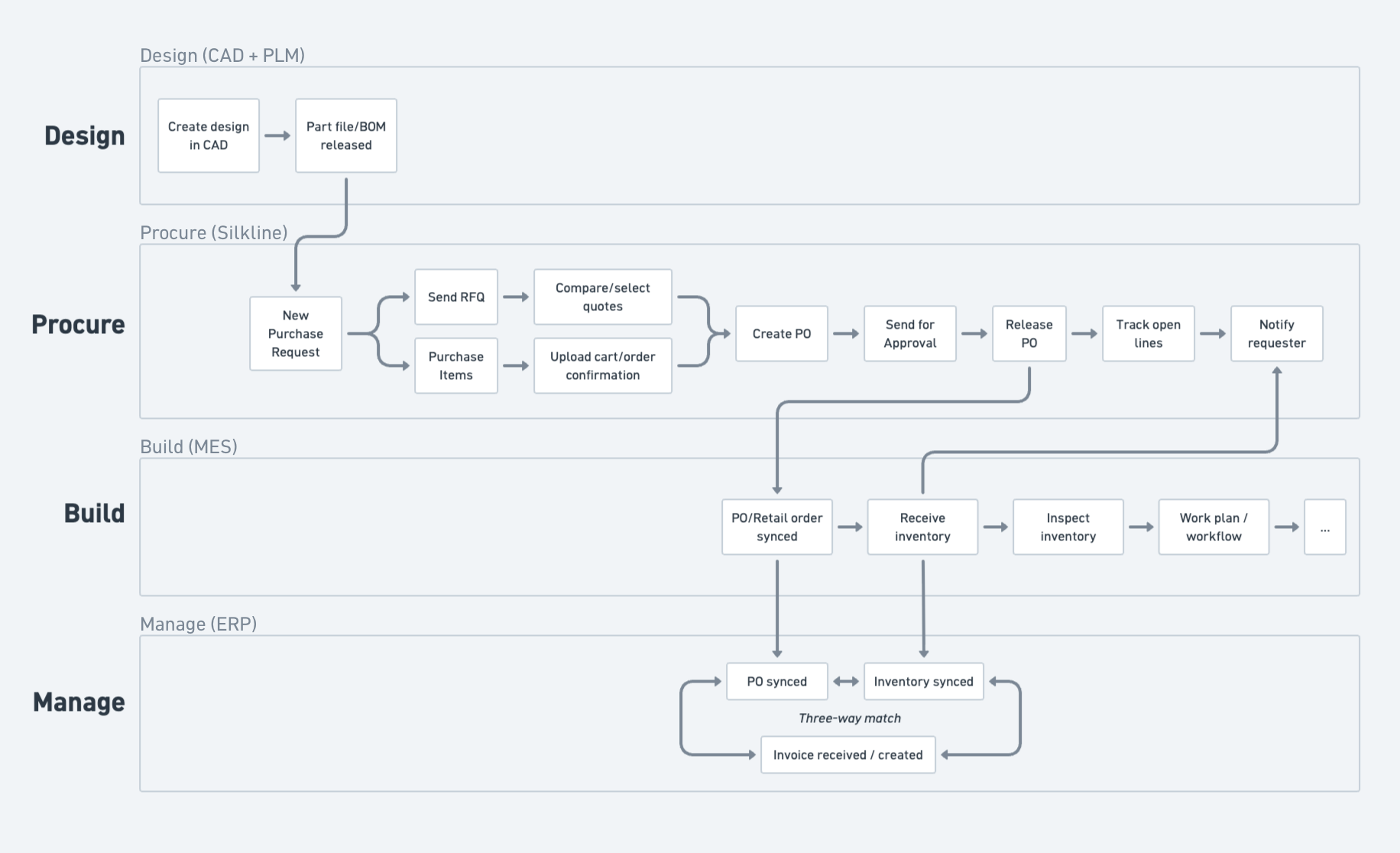
A procurement orchestration system provides a dedicated operational layer that connects these activities into a coherent workflow. Rather than replacing systems of record, it organizes the work that happens before, between, and around them. From a practical standpoint, procurement orchestration enables organizations to:
- Intake and manage purchase requests in a structured way
- Issue and track RFQs with current revisions and documentation
- Capture and compare supplier quotes consistently
- Coordinate approvals across functions
- Track purchase orders, milestones, and supplier commitments
- Maintain visibility into changes that affect production and quality
- Ensure quality and compliance in support of engineering and production
Procurement Orchestration vs. ERP
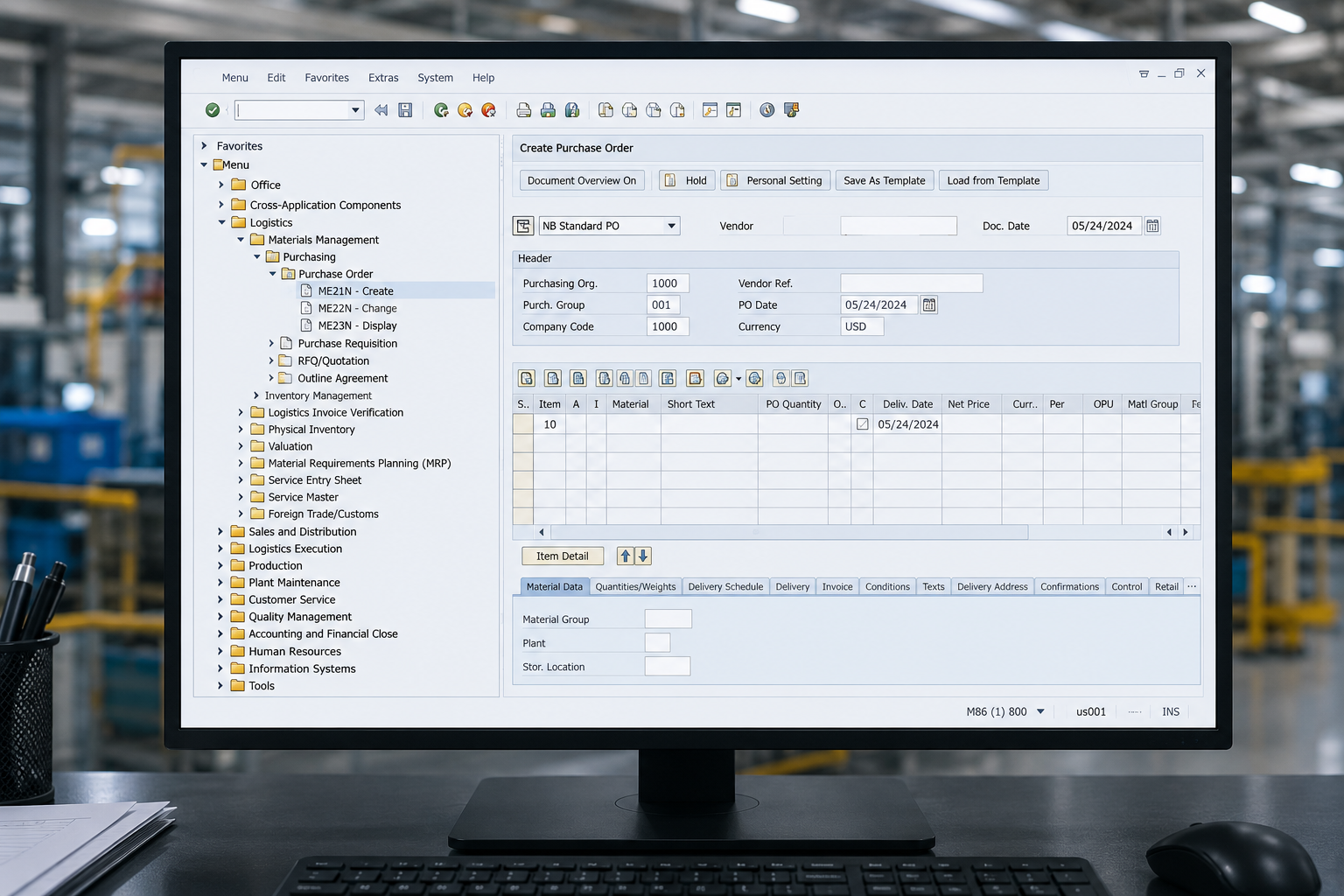
Most manufacturing organizations rely on an ERP system to manage procurement data. ERP platforms remain essential for financial control, inventory accounting, and transactional accuracy.
What ERPs do well for procurement:
- System of record for manufacturing, MRP, and finance
- BOMs, item master, POs, and cost tracking
- Production planning and execution
- Standard purchasing and financial controls
- Financial, inventory, and compliance reporting
ERP systems are not designed to manage the full coordination effort required in modern procurement environments. Much of the work that determines procurement outcomes, including supplier communication, quote evaluation, approval routing, and follow-up, occurs outside the ERP.
Where ERPs fall short in procurement:
- Visibility, search, reporting, and collaboration
- Sourcing capabilities, including RFQs quote comparisons
- Communications (email integration and tracking)
- Parsing and assembling documents form data
- Adaptability and innovation due to rigidity
Procurement orchestration addresses this gap by managing procurement workflows upstream of ERP transactions. It ensures that when data enters the ERP, it reflects decisions that have already been coordinated, reviewed, and aligned across teams.
Procurement orchestration complements the ERP by improving the quality and reliability of the information it receives, rather than attempting to replicate ERP functionality.
Procurement Orchestration and MES: Order of Operations
Manufacturing Execution Systems (MES) depend on accurate material availability, stable purchase orders, and timely supplier delivery. When procurement coordination is fragmented, managed across email, spreadsheets and PDFs, MES implementations can struggle to deliver value.
Organizations typically find that establishing procurement orchestration either before or alongside MES deployment improves system performance. With clearer visibility into supplier commitments and procurement status, MES systems can operate on more reliable inputs.
Operational and Organizational Impact
The impact of procurement orchestration can be seen across multiple dimensions of an advanced manufacturing organization.
- Teams gain shared visibility into procurement status, reducing reliance on informal updates and manual follow-ups.
- Quote evaluation becomes more consistent.
- Approval cycles shorten as context is centralized.
- Supplier communication becomes easier to manage.
From a supply chain perspective, procurement orchestration contributes to improved predictability. Changes are surfaced earlier, and their downstream effects are easier to assess. This supports better decision-making in production planning and risk management.
Procurement orchestration also supports governance and compliance by ensuring that documentation, approvals, and supplier records are attached to real procurement workflows rather than managed separately.
Who Needs to Benefit from Procurement Orchestration
Procurement orchestration delivers value across the organization, not only within supply chain teams.
- Procurement and sourcing leaders benefit from improved coordination and reduced manual effort.
- Engineering teams gain confidence that design changes are reflected accurately in procurement activity.
- Manufacturing and operations leaders gain greater visibility into material readiness.
- Quality and compliance teams benefit from improved traceability.
- Executive leadership gains a clearer picture of supply chain risk and execution status.
Because the supply chain touches so many functions, procurement orchestration works best when it is treated as a strategic effort rather than a departmental tool.
How Silkline Fits in the Advanced Manufacturing Tech Stack
Silkline is designed to function as a procurement orchestration layer purpose-built for advanced manufacturing environments.
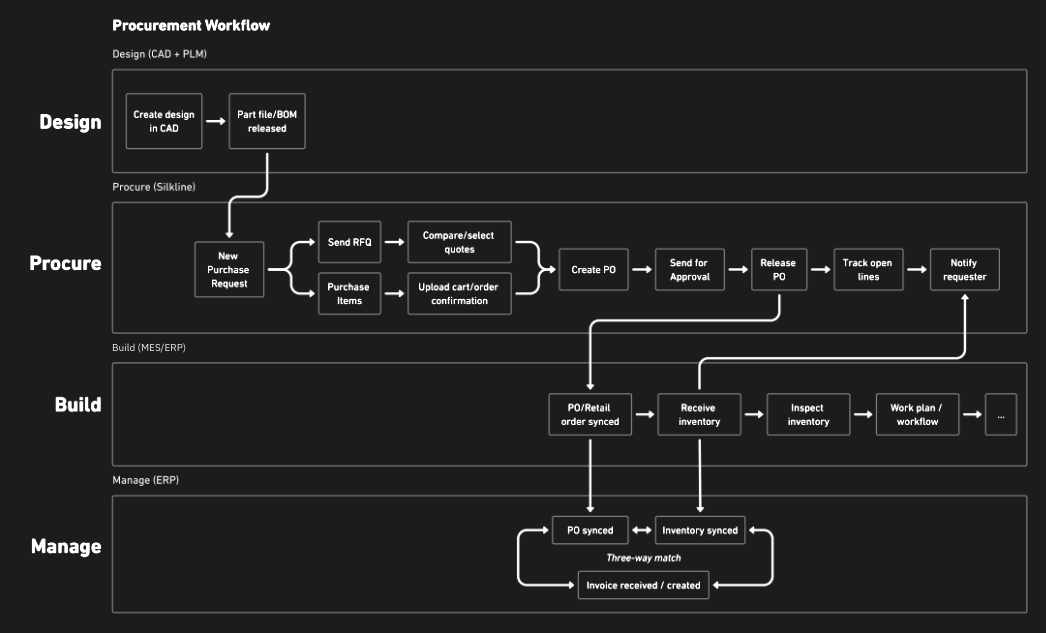
It integrates with ERP, MES, and PLM systems while organizing procurement workflows that typically exist outside those platforms. Silkline captures procurement activity as it occurs and provides structured visibility without requiring suppliers to adopt new systems.
This approach allows organizations to improve procurement coordination and operational workflows without disrupting established supplier relationships. Silkline’s design reflects the realities of engineering-driven manufacturing, where flexibility, traceability, and minimal friction are essential.
As organizations modernize manufacturing operations, procurement orchestration is emerging as a necessary component of modern supply chain management.
See how advanced manufacturers are running procurement orchestration workflows alongside ERP, MES, and PLM systems.
About Silkline
Silkline is the supply chain orchestration platform that advanced manufacturing companies use to collaborate with suppliers; track requests, RFQs, quotes, and orders; and monitor team and vendor performance. Our technology sets the standard for how OEMs engage their supply base and is the connective layer for hard tech supply chains. Hundreds of advanced manufacturers use Silkline to operate more efficiently and speed up time to revenue. The company is headquartered in Chicago, IL. For additional information, visit https://www.silkline.ai.
© 2026 Silkline, Inc. All rights reserved. Silkline and the Silkline logo are trademarks of Silkline, Inc. All other brand and product names are trademarks or registered trademarks of their respective holders.